

Why Gummy Quality Control Testing Standards Matter
For B2B buyers sourcing gummy supplements and confections from overseas manufacturers, understanding gummy quality control testing standards is essential to protecting brand reputation, ensuring regulatory compliance, and avoiding costly product recalls. A robust quality control (QC) system covers every stage — from incoming raw material inspection through in-process monitoring to final finished-product release testing.
In standard gummy manufacturing facilities, quality control personnel typically account for 8–15% of total factory headcount. Each production batch must pass no fewer than 10 individual tests before release. When properly implemented, a comprehensive QC system can keep safety-related defect rates below 0.5‰.
Gummy products carry inherent quality risk factors that demand rigorous oversight:
- High moisture content — creates conditions favorable for microbial growth during storage and distribution.
- Low-dose functional ingredients — vitamins, minerals, and botanicals added at small quantities risk uneven distribution and label-claim discrepancies.
- Lengthy production workflows — cooking, depositing, drying, and packaging each introduce potential quality variation points.
- Import-country inspections — products must pass official testing at the destination country’s border; any non-conformance results in batch rejection or return.
The consequences of quality control failures are severe and often irreversible: economic losses from batch destruction and recalls; brand damage from consumer complaints and negative media coverage; legal penalties under food safety legislation; and loss of channel partnerships with distributors, retail chains, and e-commerce platforms.
Quality control is not an optional cost — it is a long-term risk management investment. Compliant manufacturers dedicate ongoing resources to QC personnel, analytical equipment, and laboratory operations.
The Three Lines of Defense in Gummy Quality Control
A well-structured gummy factory implements a three-tier inspection framework, with dedicated QC staff independently managing each tier. This multi-layered approach is the backbone of effective gummy quality control testing standards.
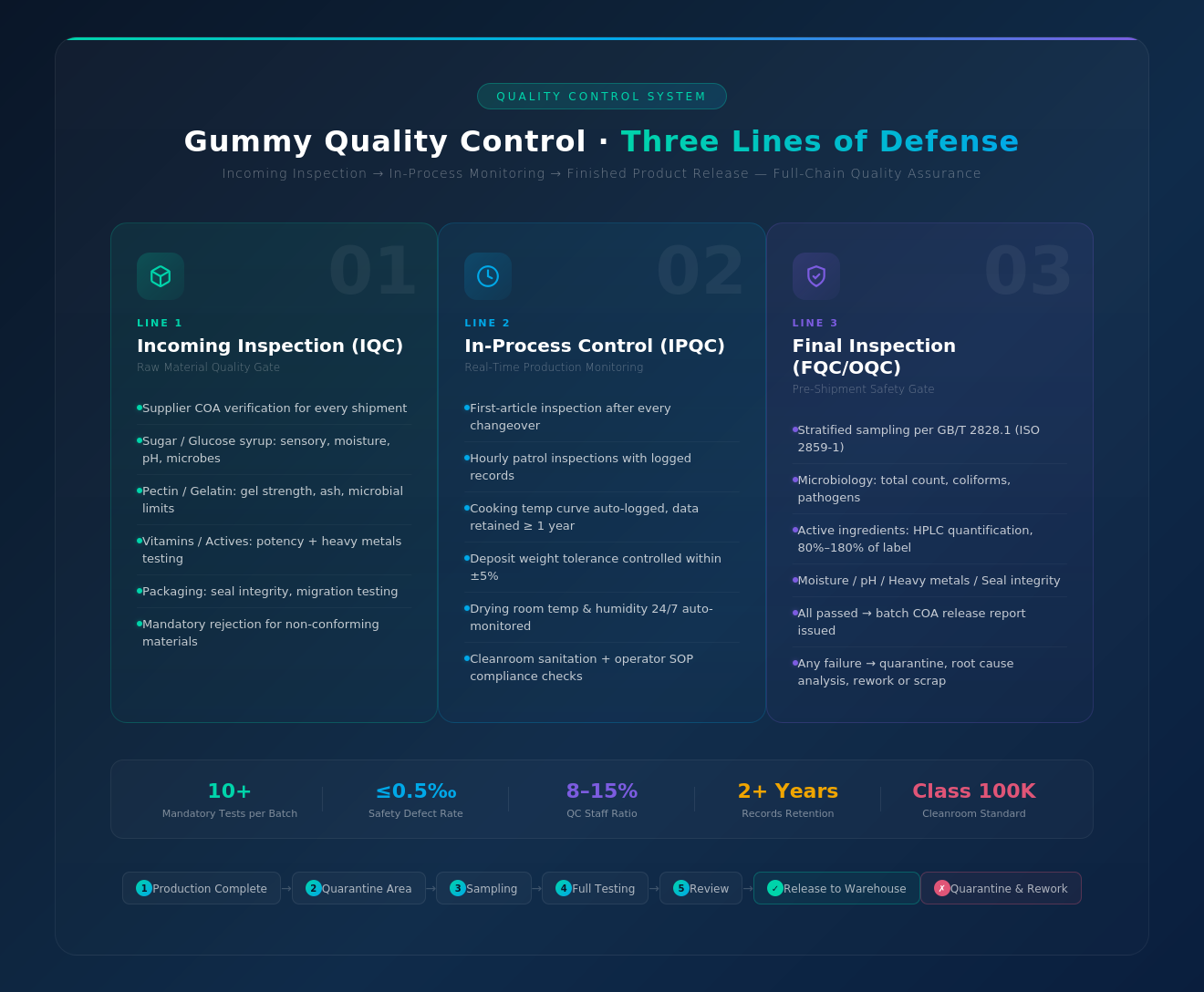
First Line of Defense: Incoming Quality Control (IQC)
Raw material quality determines finished product baseline quality. IQC is the critical gate for source-level risk control.
Standard Incoming Inspection Workflow:
- Warehouse staff verify batch number, specification, production date, and delivery documentation upon arrival.
- QC personnel perform representative sampling per national standards and internal SOPs.
- Each raw material is tested against its specific inspection checklist.
- Conforming materials are warehoused; non-conforming materials receive red isolation labels and are returned — never released to production.
Mandatory Incoming Inspection Items by Raw Material Type:
| Raw Material | Mandatory Tests | Reference Standard |
|---|---|---|
| Sugar / Glucose Syrup | Sensory, moisture, sweetness, pH, microbial | GB/T 317-2018 (Refined Sugar); GB 17399-2014 (Confectionery Safety) |
| Pectin / Gelatin | Gel strength, moisture, ash, microbial limits | GB 2760-2014 (Food Additives General Standard) |
| Vitamins / Functional Ingredients | Active content, moisture, microbial, heavy metals | Supplier COA + in-house re-testing; third-party testing for export products |
| Flavorings / Colorants | Sensory (color/odor), active content, microbial, heavy metals | GB 2760-2014 |
| Food-Contact Packaging | Appearance, print compliance, seal integrity, microbial, migration testing | GB 4806 series (Food Contact Materials) |
Core IQC Management Requirements:
- All raw materials must arrive with the supplier’s original Certificate of Analysis (COA). Materials without a COA are rejected at intake.
- Key ingredients (vitamins, botanical extracts, gelling agents) must be independently re-tested by the factory — supplier reports alone are insufficient.
- An approved supplier list is maintained; on-site supplier audits and qualification reviews are conducted semi-annually.
- Non-conforming materials are mandatorily returned. A dedicated non-conforming material isolation area is maintained; concessionary acceptance is prohibited.
Second Line of Defense: In-Process Quality Control (IPQC)
IPQC encompasses first-article verification, periodic line patrols, and real-time monitoring of critical process parameters. The goal is to catch deviations early — before they escalate into large-scale batch losses.
1. First-Article Inspection
At each production start-up, product changeover, batch switch, or raw material lot change, the first mold of output must undergo full-parameter testing. A first-article inspection report is issued, and both QC and production managers must co-sign before bulk production begins.
2. In-Line Patrol Inspection
QC personnel patrol the production line every 2 hours, recording inspections covering:
- Cooking temperature and holding time versus process specifications
- Deposit weight and molded piece dimensions
- Workshop temperature, humidity, clean-room disinfection records
- Operator compliance with gowning, hand sanitization, and PPE protocols
- Semi-finished product sensory attributes, hardness, and real-time moisture spot checks
3. Critical Process 24/7 Monitoring
- Cooking equipment auto-records temperature curves; raw data is retained for a minimum of 1 year.
- Deposit weight is continuously sampled — typical tolerance for 2–5 g gummies is ±5%; larger formats follow product-specific standards.
- Drying rooms are equipped with fully automated 24-hour temperature and humidity logging, with automatic alerts on deviations.
The value of IPQC: Relying solely on finished-goods inspection means discovering process defects only after entire batches of semi-finished product are completed. IPQC allows real-time parameter correction when deviations first appear, significantly reducing production waste and quality costs.
Third Line of Defense: Finished Product Inspection (FQC/OQC)
Finished product inspection is divided into inbound warehouse inspection (FQC) and pre-shipment release inspection (OQC). This is the final safety gate before products reach the market. All parameters must pass for batch release.
Standard Finished Product Inspection Workflow:
- Completed production is transferred to a dedicated quarantine hold area.
- QC personnel perform stratified sampling per GB/T 2828.1 (ISO 2859-1 equivalent).
- Sequential testing: sensory → physicochemical → functional ingredient content → microbial → packaging/label.
- When all parameters pass, a batch COA (Certificate of Analysis) is issued and product is moved to the conforming goods warehouse.
- Any single failing parameter triggers quarantine, root-cause investigation by QC and technical teams, and a rework-or-scrap decision.
Mandatory Release Test Panel: Sensory attributes, individual piece net weight / container weight deviation, moisture, pH, reducing sugar / total sugar, microbial limits, labeled functional ingredient content, package seal integrity, label compliance.
Management rule: If any test item fails, the batch is prohibited from shipment. Release occurs only after root-cause analysis and corrective/preventive actions are completed.
Core Gummy Testing Parameters Explained
Microbial Testing — Tier 1 Food Safety Indicator
Microbial parameters directly determine product safety for consumption. Full-panel testing follows the GB 4789 series standards.
Microbial Limits by Product Category:
| Parameter | Significance | Standard Gummy | Health-Supplement Gummy |
|---|---|---|---|
| Total Plate Count (TPC) | Overall workshop and raw material hygiene level | ≤ 10,000 CFU/g | ≤ 1,000 CFU/g |
| Coliforms | Indicator of fecal contamination / pathogen risk | ≤ 10 MPN/100 g | Not detectable |
| Mold & Yeast | Shelf-life spoilage / moisture-out risk predictor | ≤ 100 CFU/g | ≤ 50 CFU/g |
| Pathogens (Salmonella, S. aureus) | Direct human health hazard | Not detectable | Not detectable |
Common causes of microbial exceedance:
- Insufficient clean-room disinfection frequency — airborne, surface, and operator-borne contamination
- Incoming raw materials with elevated microbial loads — IQC gaps
- Packaging seal performance below spec — secondary contamination during storage and transit
- Finished product moisture exceeding target — creates favorable microbial growth environment
Microbial control system:
- ISO Class 8 (100,000-grade) clean-room production; scheduled ozone/alcohol disinfection of air and surfaces; monthly settle-plate monitoring
- Personnel follow double-gowning, hand sanitization, and air-shower entry protocols
- Cooking, depositing, and packaging equipment disassembled, cleaned, and sanitized at every shift change
- Raw materials screened for microbial load on a per-lot basis; finished goods undergo seal integrity pressure testing per batch
Functional Ingredient Content Testing
For gummies fortified with vitamins, minerals, or botanical extracts, active ingredient content is the primary compliance metric within gummy quality control testing standards.
Commonly tested categories:
- Vitamins: C, B-complex, D, E, biotin, folic acid
- Minerals: calcium, iron, zinc, selenium
- Compound actives: collagen, probiotics, sodium hyaluronate, fruit/vegetable extracts
Testing methods:
- HPLC (High-Performance Liquid Chromatography) — highest accuracy; applicable to most vitamins and botanical extracts
- Titrimetric methods — low equipment cost; supplementary rapid screening only, not used for final determination
- Microbiological assay — specific to vitamins like B12
- Atomic Absorption Spectrophotometry (AAS) — quantitative analysis of mineral/metallic elements
Three critical content-control requirements:
- Piece-level uniformity: Beyond batch-average content, multiple individual pieces must be randomly sampled and tested separately. Severe single-piece over- or under-dosing is prohibited.
- Label-claim compliance ranges: Health-supplement nutrient content must fall within 80–180% of the labeled value. U.S. export products must meet FDA requirements (100–150% of label claim). Conventional pre-packaged foods have no mandated range, but label values must reasonably match actual test results.
- Shelf-life stability verification: Meeting specs at production date does not guarantee full-shelf-life compliance. Accelerated stability testing (constant temperature/humidity) must verify that active ingredient degradation remains within acceptable limits throughout the declared shelf life. Formulation includes a deliberate overage to compensate for projected decay.
Moisture Content Testing
Moisture directly affects texture, shelf life, and microbial growth rate in gummy products.
Impact of moisture on product quality:
- Texture: Excess moisture leads to sticky, deformed pieces; insufficient moisture results in hard texture with poor chewability
- Shelf life: Higher moisture accelerates mold and bacterial growth, shortening product lifespan
- Ingredient stability: High moisture environments accelerate vitamin and active extract oxidation and degradation
Three testing methods:
- Loss-on-drying (LOD) — national standard reference method; precise but time-consuming
- Rapid moisture analyzer — on-site rapid screening; results in minutes
- Karl Fischer titration — precise trace-moisture measurement for low-moisture specialty formulations
Moisture control ranges by gelling agent:
- Gelatin gummies: 15–18%
- Pectin gummies: 18–22%
- Starch-based gummies: 10–15%
- Sugar-free and filled/burst-core gummies: formulation-specific internal standards
The critical moisture control point is the drying room — drying temperature and duration are matched to gelling agent type and ambient humidity conditions.
pH Testing
While pH does not directly determine safety, it significantly affects gel formation, flavor balance, and active ingredient stability.
- Gel formation: Pectin and gelatin gel systems are pH-sensitive; deviations cause setting failures or structural collapse
- Ingredient stability: Vitamins and active extracts degrade rapidly at extreme pH levels
- Flavor balance: pH determines the sweet-sour ratio, directly impacting consumer taste perception
Standard internal pH range: 3.0–4.5, adjusted per citric acid dosage and gelling agent type.
Heavy Metal Testing — Mandatory for Domestic and Export Markets
Tested elements: Lead (Pb), Inorganic Arsenic (As), Total Mercury (Hg), Cadmium (Cd). Testing follows GB 2762 (Contaminant Limits in Food). Export products must additionally comply with destination-country limits.
Three primary heavy metal contamination sources:
- Botanical raw materials accumulating heavy metals from cultivation soil
- Metal ion leaching from production piping and equipment
- Environmental contamination during raw material cultivation and processing
Full-chain control measures:
- All incoming raw materials screened for heavy metals; non-conforming lots isolated and returned
- Food-grade stainless steel production equipment and transfer piping throughout
- Finished products tested quarterly for heavy metals; export orders include additional per-shipment testing
Additional Supporting Test Parameters
- Sensory evaluation: appearance, color, aroma, taste, shape — screening for foreign objects, off-odors, deformation
- Weight deviation: individual piece and container net weight verification per pre-packaged goods regulations
- Ash content: indicates inorganic substance and impurity levels
- Reducing sugar / total sugar: controls sugar ratio for taste consistency and storage stability
- Package seal integrity: negative-pressure / pressure decay leak testing to prevent transit-related spoilage
- Label audit: GB 7718 (food labeling), GB 28050 (nutrition labeling), additive declarations, and health claim compliance verification
In-House vs. Third-Party Testing: A Combined Strategy
Factory In-House Testing
Use cases: Every-batch routine release testing, rapid in-line process monitoring, real-time control of standard physicochemical parameters.
- Advantages: Fast turnaround (1–2 days); low per-test cost; enables full-coverage testing of every batch
- Limitations: Lower external credibility; inability to perform specialized tests requiring large-scale instrumentation; risk of human data bias
Third-Party Laboratory Testing
Use cases: New customer factory audits, new product market registration, customer-requested third-party reports, quality dispute arbitration, export customs clearance, regulatory sampling challenge review.
- Advantages: Legally defensible results; full test panel coverage with accredited equipment and qualified personnel; objective, independent data
- Limitations: Higher per-test cost; standard turnaround 3–7 business days; impractical for every-batch testing
Standard Combined Execution Strategy
- Factory in-house testing serves as the baseline — all batches complete internal testing and receive a COA report.
- A quarterly or semi-annual third-party full-panel testing program is established to cross-validate laboratory accuracy.
- New products, large export orders, and new channel partnerships trigger additional third-party specialized testing.
Release Testing Workflow and Retention Sample Management
Complete Release Testing Workflow
Production complete → transfer to quarantine hold → stratified sampling (test samples / retention samples / re-test samples) → sensory testing → physicochemical analysis → functional ingredient quantification → microbial culture testing (2–3 days) → packaging/label verification → comprehensive conformance determination → batch COA issuance → conforming goods warehoused / non-conforming goods quarantined for root-cause review (rework or scrap).
Note: Microbial testing requires a 2–3 day culture period. Other tests proceed in parallel; final batch determination occurs only after all parameters are complete.
Applicable Standards by Target Market
- China domestic market: GB 17399, GB 2760, GB 2762, GB 7718, GB 16740 (health foods), GB 4789 microbial series
- U.S. market: FDA food regulations, USP (United States Pharmacopeia) standards
- EU market: EC 178/2002 general food law, associated additive and contaminant directives
- International: Codex Alimentarius standards
Manufacturers match testing limits and acceptance criteria to the target sales region for each product.
Retention Sample Management
- Every production batch must retain sufficient samples, individually sealed with complete batch identification.
- Storage differentiated by product type: standard gummy retention samples held until 6 months past shelf life; health-supplement gummy samples held until 12 months past shelf life.
- Retention sample purposes: quality dispute re-testing, shelf-life stability tracking, food safety incident traceability.
- Factories without a formal retention sample protocol are considered to have an incomplete quality system and lack compliant release authorization.
Buyer QC Verification Guide
On-Site Factory Audit Checklist
- QC organization: independent QC department, dedicated QC headcount, analytical instrument inventory
- Standardized laboratory: environmental hygiene, instrument calibration certificates, equipment usage logs
- Raw quality records: randomly request historical batch test reports, patrol records, first-article reports
- Non-conforming product control: dedicated quarantine area, documented non-conformance disposition procedures
- Production floor management: clean-room zoning, personnel sanitization protocols, current hygiene execution
Ongoing Incoming Batch QC Measures for Buyers
- Request the factory’s original COA for every shipment; cross-check each parameter.
- Random-sample incoming goods for appearance, packaging print quality, label accuracy, and net weight.
- Periodically send blind samples to an independent third-party lab to verify factory self-test data integrity.
- Maintain a consumer feedback log; escalate taste, spoilage, or foreign-object complaints to the factory for joint root-cause analysis.
Quality Issue Escalation Protocol
- Evidence preservation: seal non-conforming samples; photograph; retain both parties’ test reports.
- Timely communication: notify factory within 48 hours of receipt; clearly define issue type.
- Joint root-cause analysis: classify by raw material, process, storage/transport, or packaging origin.
- Negotiated resolution: minor defects — supplemental replacement; safety-critical failures — full batch return/exchange plus compensation.
- Long-term prevention: require written corrective and preventive action (CAPA) plan; increase inspection severity for subsequent batches.
Laboratory Infrastructure Management Essentials
Beyond test procedures, the underlying laboratory management system is what sustains reliable gummy quality control testing standards over time.
- Instrument calibration: HPLC, pH meters, analytical balances, moisture analyzers, and autoclaves must undergo annual third-party metrological calibration. Calibration certificates are archived.
- Personnel qualifications: Microbial and physicochemical testing staff must hold food inspection certifications.
- Record archiving: All IQC/IPQC/FQC records, raw chromatograms, disinfection logs, and retention sample logs are archived for a minimum of 2 years.
- Warehouse environment control: Finished goods warehouse maintains temperature and humidity monitoring. Long-term inventory is re-sampled quarterly for sensory and moisture re-testing.
Summary: Quality Control as a Competitive Advantage
Quality control is not a formality — it is a systematic discipline executed through a complete management framework, standardized procedures, professional analytical equipment, and dedicated QC personnel. Manufacturers that prioritize building a comprehensive QC system may incur slightly higher production costs, but they avoid the far greater risks of large-scale quality incidents, brand reputation damage, and regulatory penalties.
Factories certified under ISO 22000 (Food Safety Management System) and HACCP (Hazard Analysis and Critical Control Points) can provide the full suite of quality documentation — batch COA reports, third-party verification, and complete traceability records — ensuring that every stage of the supply chain is auditable and verifiable.
For B2B buyers evaluating gummy manufacturing partners, requesting detailed documentation of these gummy quality control testing standards — including sample COAs, lab accreditation certificates, and retention sample policies — is the most effective way to assess a factory’s true quality capability.
Looking for a gummy manufacturing partner with a proven quality control system? Contact our team to request a factory audit invitation, sample kit, or detailed QC documentation package. We provide full transparency across every stage of production — from raw material sourcing to finished product release.